Time-and-a-Half Formula
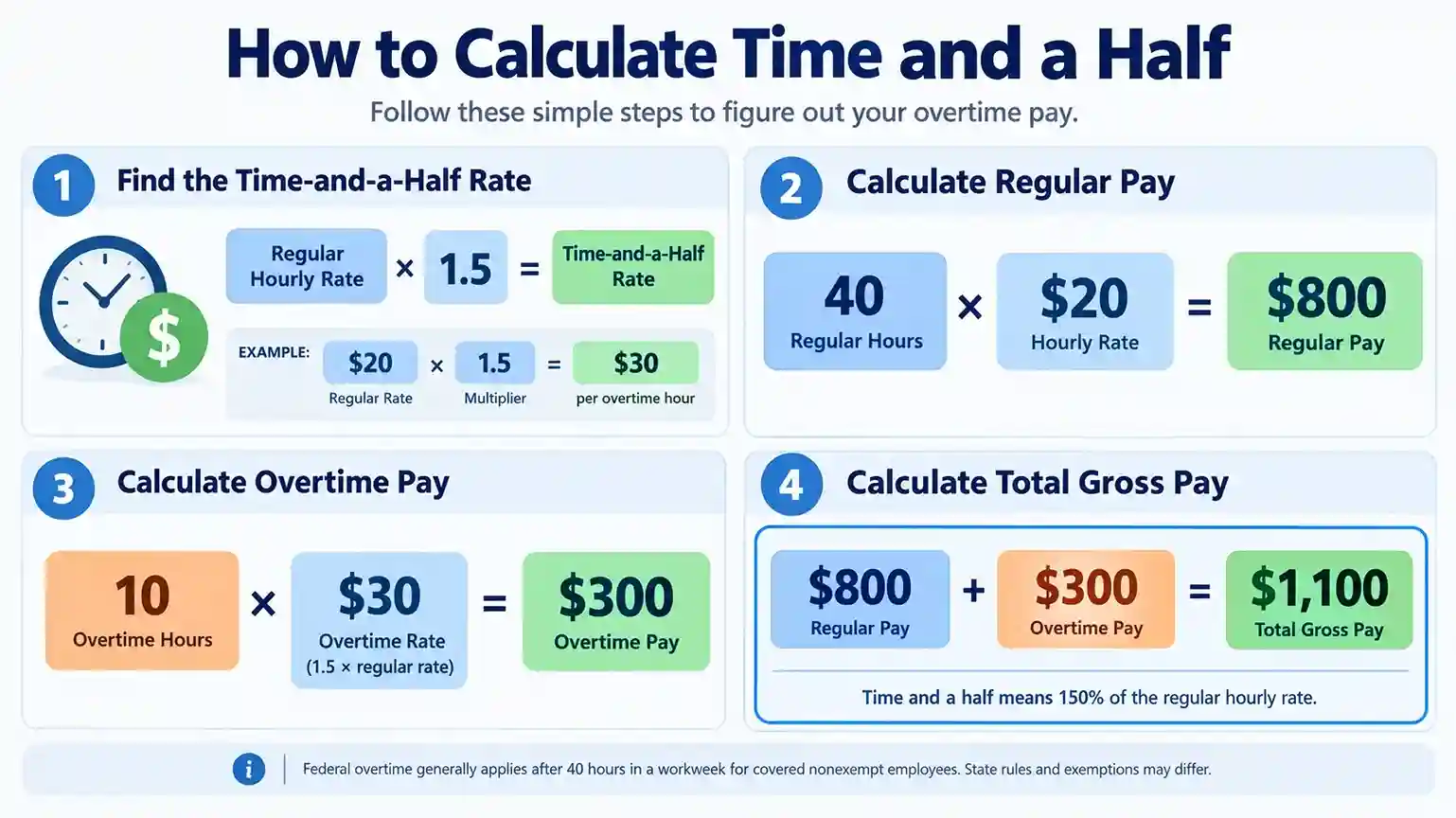
To calculate time and a half, multiply the regular hourly rate by 1.5. If the regular rate is $20 per hour, the time-and-a-half rate is $30 per hour.
For a complete weekly paycheck, calculate regular earnings and overtime earnings separately, then add them together. Under the federal Fair Labor Standards Act, covered nonexempt employees generally must receive at least one and one-half times their regular rate for hours worked over 40 in a workweek.[1][2]
Calculate Your Overtime Pay
Enter your hourly rate and hours worked to calculate regular pay, overtime wages, gross pay, and an estimated amount after tax.
What Does Time and a Half Mean?
Time and a half means an employee receives 150% of the regular hourly rate for qualifying overtime hours. The payment contains the normal hourly rate plus an additional 50% premium.
At a regular rate of $18 per hour, the normal $18 remains part of the overtime rate and the extra half is $9. The time-and-a-half rate is therefore $27 per overtime hour.
Time and a half is often used as another name for an overtime rate, but the two terms are not always interchangeable. An employer agreement or state rule may provide a different multiplier, and some hours may qualify for double time instead.
How to Calculate Time-and-a-Half Pay
Finding the overtime hourly rate is only the first step. To calculate total pay for a workweek, separate regular hours from overtime hours.
- Identify the regular hourly rate.
- Multiply the regular hourly rate by 1.5.
- Multiply regular hours by the regular rate.
- Multiply overtime hours by the time-and-a-half rate.
- Add regular pay and overtime pay.
Total Gross Pay = Regular Pay + Overtime Pay
Worked example: $22 per hour with eight overtime hours
Assume an employee earns $22 per hour and works 48 hours in one workweek. Under a basic federal calculation, 40 hours are regular and eight are overtime.
| Calculation | Formula | Result |
|---|---|---|
| Time-and-a-half rate | $22 × 1.5 | $33.00 |
| Regular pay | 40 × $22 | $880.00 |
| Overtime pay | 8 × $33 | $264.00 |
| Total gross pay | $880 + $264 | $1,144.00 |
Do not multiply all 48 hours by 1.5. In this example, only the eight overtime hours receive the time-and-a-half rate.
How to Work Out Overtime Hours
Under the standard federal rule, overtime hours are the hours worked beyond 40 in a fixed seven-day workweek. Each workweek generally stands on its own, so hours cannot normally be averaged across two or more weeks to avoid overtime.[2][3]
If an employee works 45 hours, there are five overtime hours. If an employee works 38 hours, there are no federal weekly overtime hours. State laws or employment agreements can provide additional rights.
How to Calculate Time and a Half on a Salary
Being paid a salary does not automatically mean an employee is exempt from overtime. Some salaried employees are nonexempt. Actual eligibility depends on legal tests and job facts, not the word “salary” alone.
If a nonexempt annual salary covers 40 hours per week, a simplified hourly equivalent can be calculated as follows:
Hourly Equivalent = Weekly Salary ÷ 40
Time-and-a-Half Rate = Hourly Equivalent × 1.5
Example using a $52,000 annual salary
This shortcut is suitable only when the salary is understood to cover 40 hours and the employee is eligible for overtime under that method. The Department of Labor explains that earnings can be based on salary, commission, piece rate, or another basis, but overtime must still be calculated from the applicable regular rate.[2][3]
Use the Salary Calculator to convert annual compensation into weekly, monthly, and hourly figures before estimating overtime.
Time-and-a-Half Rate Chart
The table below multiplies each regular hourly wage by 1.5. Use the Overtime Calculator when you also need weekly earnings, weighted rates, California daily overtime, or a tax estimate.
| Regular hourly rate | Time-and-a-half rate |
|---|---|
| $10.00 | $15.00 |
| $12.00 | $18.00 |
| $15.00 | $22.50 |
| $16.00 | $24.00 |
| $17.00 | $25.50 |
| $18.00 | $27.00 |
| $19.00 | $28.50 |
| $20.00 | $30.00 |
| $22.00 | $33.00 |
| $24.00 | $36.00 |
| $25.00 | $37.50 |
| $28.00 | $42.00 |
| $30.00 | $45.00 |
| $35.00 | $52.50 |
| $40.00 | $60.00 |
| $50.00 | $75.00 |
Is Time and a Half Required on Weekends or Holidays?
Federal law does not automatically require time-and-a-half pay merely because work occurs on Saturday, Sunday, a holiday, or a normal day of rest. The federal requirement generally depends on a covered nonexempt employee working more than 40 hours in the workweek. An employer policy, collective bargaining agreement, or state law may provide additional premium pay.[1][2]
Does Time and a Half Apply After Eight Hours?
The standard federal rule generally applies after 40 hours in a workweek rather than after eight hours in one day. Some states impose daily overtime rules. The existing Overtime Calculator includes a general California daily-and-weekly mode, but exemptions, alternative schedules, seventh-day rules, and industry provisions may change the result.
Time and a Half With Two Hourly Rates
If an employee works at two or more straight-time rates during one workweek, overtime may be based on a weighted regular rate. The general weighted rate adds straight-time earnings from all included rates and divides the total by all hours worked.[2][3]
For example, 30 hours at $18 equals $540 and 15 hours at $24 equals $360. Straight-time earnings total $900 across 45 hours, producing a weighted regular rate of $20. Because straight-time pay has already been included for all 45 hours, the five overtime hours generally require an additional half-time premium of $10 per hour, or $50, under this simplified example.
Time and a Half With Taxes
Time-and-a-half calculations normally show gross pay before taxes and payroll deductions. The amount deposited can be lower after federal income-tax withholding, Social Security, Medicare, state or local tax, insurance, retirement contributions, and other deductions.
Withholding on a larger overtime check is not necessarily the same as final annual tax liability. Use the Tax Calculator for a broader estimate and review current payroll records for a paycheck-specific comparison.
Common Time-and-a-Half Mistakes
- Multiplying every hour by 1.5: Under a basic weekly calculation, only qualifying overtime hours receive the overtime rate.
- Forgetting regular pay: Total gross pay includes both regular earnings and overtime earnings.
- Using the wrong base rate: Bonuses, commissions, piece rates, or multiple rates can affect the regular rate.
- Assuming weekend work is automatically overtime: Federal overtime generally depends on weekly hours, not the name of the day.
- Averaging separate workweeks: A long week generally cannot be offset by a shorter week for federal overtime purposes.
- Assuming all salaried employees are exempt: Salary payment alone does not decide overtime eligibility.
- Confusing time and a half with double time: Time and a half is 1.5 times the regular rate; double time is 2 times the regular rate.
Frequently Asked Questions
How do you calculate time and a half?
Multiply the regular hourly rate by 1.5. A $20 regular rate produces a $30 time-and-a-half rate.
What is time and a half for $15 an hour?
It is $22.50 per hour because $15 multiplied by 1.5 equals $22.50.
What is time and a half for $18 an hour?
It is $27 per hour because $18 multiplied by 1.5 equals $27.
What is time and a half for $20 an hour?
It is $30 per hour because $20 multiplied by 1.5 equals $30.
How do you calculate total overtime pay?
Multiply overtime hours by the time-and-a-half hourly rate, then add regular earnings to find total gross pay.
How do you calculate time and a half on salary?
If an eligible nonexempt salary covers 40 hours, divide annual salary by 52 and then by 40 to estimate the hourly equivalent. Multiply that amount by 1.5. Actual methods can differ.
Does time and a half apply on weekends?
Federal law does not automatically require it solely because work occurs on a weekend. Weekly hours, coverage, classification, state law, and employment agreements matter.
Is double time the same as time and a half?
No. Time and a half is 1.5 times the regular rate. Double time is 2 times the regular rate.
Final Takeaway
The basic time-and-a-half formula is straightforward: multiply the regular hourly rate by 1.5. To calculate a complete paycheck, separate regular hours from qualifying overtime hours, calculate each amount, and add the results.
Use the regular rate that applies to the workweek and check whether bonuses, several pay rates, salary terms, state rules, or an exemption affect the calculation. For a quick estimate, enter the rate and hours in the Overtime Calculator.