A rental property can collect steady rent and still produce a weak return. Mortgage payments, vacancy, repairs, property taxes, insurance, management fees, and closing costs may consume more income than expected.
Return on investment, or ROI, compares what a property earns with the amount invested. The basic formula is:
The formula is simple. Choosing the correct net return and investment amount takes more care. The calculation also changes depending on whether the property was purchased with cash or financed with a mortgage.
What Is Rental Property ROI?
Rental property ROI measures the return generated by a property relative to the amount invested. If an investor puts $80,000 into a rental property and receives $8,000 in annual pre-tax cash flow, the simple annual return is:
This result measures annual cash flow against cash invested. It does not automatically include property appreciation, mortgage principal reduction, selling expenses, or income taxes.
Rental property investors therefore use several related measurements:
- Cap rate measures the property’s operating return without considering financing.
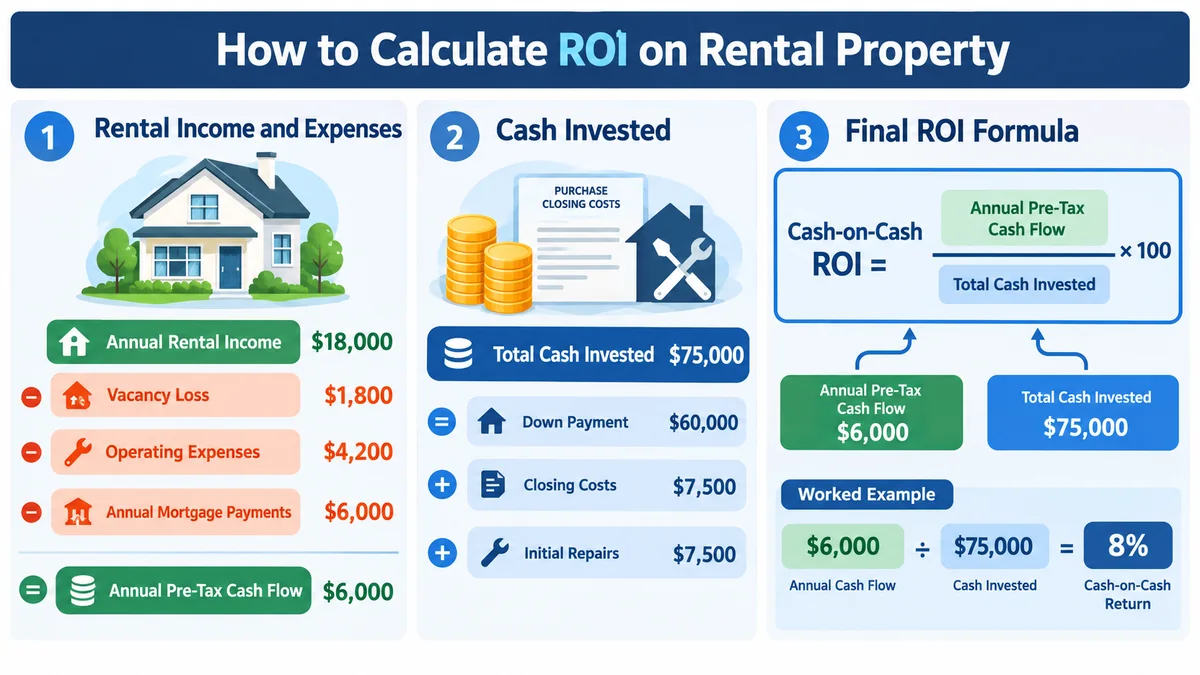
- Cash-on-cash return measures annual pre-tax cash flow against the actual cash invested.
- Simple ROI compares a defined profit with a defined investment cost.
- Total ROI can include cash flow, appreciation, principal reduction, and net sale proceeds.
- IRR accounts for the timing of several cash flows over the holding period.
These metrics answer different questions. Cap rate helps compare properties independently of financing. Cash-on-cash return shows how a down payment and other upfront cash are performing. Total ROI or IRR is more useful when evaluating the full holding period.
Calculate Your Rental Property Return
Use the Rental Property option in the ROI Calculator to estimate profit, total ROI, and annualized return.
Information Needed to Calculate Rental ROI
A rental ROI estimate is only as useful as its inputs. Collect the property’s acquisition costs, rental income, operating expenses, and financing costs before using a formula.
Property acquisition costs
- Purchase price
- Down payment
- Closing costs
- Inspection and appraisal fees
- Initial repairs and renovations
- Permit fees
- Immediate furnishing or equipment costs
- Other cash paid before the property became rentable
Rental income
- Monthly rent
- Parking fees
- Laundry income
- Pet rent
- Storage charges
- Other payments for use of the property
Do not automatically treat a refundable security deposit as rental income. Advance rent and retained security deposits may be treated differently. The IRS also explains that certain expenses paid by a tenant may need to be included as rental income.[1]
Operating expenses
- Property taxes
- Landlord insurance
- Property management
- Repairs and routine maintenance
- Homeowners association fees
- Advertising and leasing costs
- Pest control and landscaping
- Owner-paid utilities
- Legal and accounting expenses
- Vacancy allowance
- Replacement reserves
The IRS identifies rental income and rental expenses as separate reporting items. Depending on the property and applicable rules, expenses may include mortgage interest, real-estate taxes, maintenance, utilities, insurance, and depreciation.[1][2]
Financing costs
- Loan amount
- Interest rate
- Loan term
- Monthly principal and interest
- Mortgage insurance
- Loan fees and points
- Other financing charges
Mortgage payments are included when calculating annual cash flow and cash-on-cash return. They are normally excluded from net operating income and cap rate because those measurements examine property operations before financing.
Rental Property ROI Formulas
Simple rental property ROI
For an all-cash purchase, total investment may include the purchase price, closing costs, and initial repairs. For a financed property, investors often use actual cash invested instead. That calculation is usually described more accurately as cash-on-cash return.
Net operating income
Net operating income, or NOI, is the property’s income after vacancy and operating expenses but before mortgage payments and income taxes.
Assume annual scheduled rent is $30,000, expected vacancy is $1,500, and annual operating expenses are $9,500:
Capitalization rate
Using NOI of $19,000 and a purchase price of $300,000:
Because a mortgage is excluded, two buyers using different down payments can calculate the same cap rate for the same property.
Cash-on-cash return
Annual pre-tax cash flow is calculated as:
Total cash invested normally includes the down payment, closing costs, initial repairs, and other upfront cash.
Total ROI over the holding period
Total gain may include cumulative rental cash flow, net sale proceeds, appreciation, and mortgage principal reduction. The analysis should avoid counting the same cash movement twice.
How to Calculate ROI on an All-Cash Rental Property
An all-cash purchase has no mortgage payment, so annual pre-tax cash flow is equal to NOI in this simplified example.
| Item | Amount |
|---|---|
| Purchase price | $250,000 |
| Closing costs | $7,500 |
| Initial repairs | $12,500 |
| Total investment | $270,000 |
| Annual scheduled rent | $30,000 |
| Vacancy allowance | −$1,500 |
| Operating expenses | −$9,000 |
| Annual pre-tax cash flow | $19,500 |
The annual return on total cash invested is:
The cap rate uses the $250,000 purchase price rather than the full $270,000 cash investment:
The figures differ because the ROI calculation includes closing costs and repairs in the denominator, while the basic cap-rate calculation uses the purchase price.
How to Calculate ROI on Rental Property With a Mortgage
Financing changes the cash invested and the annual cash flow. A lower down payment may improve cash-on-cash return if the property produces enough income to cover debt service. It can also create negative cash flow when the mortgage is too high.
| Acquisition item | Amount |
|---|---|
| Purchase price | $300,000 |
| Down payment | $60,000 |
| Closing costs | $8,000 |
| Initial repairs | $7,000 |
| Total cash invested | $75,000 |
| Income or expense | Annual amount |
|---|---|
| Scheduled rent | $32,400 |
| Vacancy allowance | −$1,620 |
| Effective rental income | $30,780 |
| Property taxes | −$4,200 |
| Insurance | −$1,500 |
| Management | −$2,462 |
| Maintenance and repairs | −$2,400 |
| HOA and owner-paid utilities | −$1,200 |
| Net operating income | $19,018 |
| Annual mortgage payments | −$14,400 |
| Annual pre-tax cash flow | $4,618 |
The cash-on-cash return is:
The property’s cap rate is:
The cap rate and cash-on-cash return are close in this example, but they do not have to be. A larger mortgage payment could push cash-on-cash return below cap rate. Favorable financing could create the opposite result.
Use the Mortgage Calculator to estimate principal and interest before adding annual debt service to a rental analysis.
Cap Rate vs. Cash-on-Cash Return vs. Total ROI
| Metric | Formula basis | Includes financing? | Best use |
|---|---|---|---|
| Cap rate | NOI ÷ property value | No | Comparing property operations |
| Cash-on-cash return | Annual cash flow ÷ cash invested | Yes | Measuring current return on cash |
| Simple ROI | Net profit ÷ investment cost | Depends | Quick profitability estimate |
| Total ROI | Total gain ÷ cash invested | Usually | Evaluating the holding period |
| IRR | Discount rate for timed cash flows | Yes | Comparing multi-period investments |
Use cap rate when comparing property operations. Use cash-on-cash return when measuring annual return on the money personally invested. Use total ROI or IRR when evaluating several years of cash flow and a future sale.
How to Calculate Rental Property ROI in Excel
A simple spreadsheet makes the calculation easier to review and update. Create these labels:
A2: Purchase Price
A3: Down Payment
A4: Closing Costs
A5: Initial Repairs
A6: Total Cash Invested
A8: Annual Rental Income
A9: Vacancy Loss
A10: Operating Expenses
A11: Net Operating Income
A12: Annual Mortgage Payments
A13: Annual Pre-Tax Cash Flow
A14: Cash-on-Cash Return
A15: Cap Rate
Enter these formulas:
B6  = B3+B4+B5
B11 = B8-B9-B10
B13 = B11-B12
B14 = B13/B6
B15 = B11/B2
Format B14 and B15 as percentages. For a multiyear analysis, place each year in a separate column, include net sale proceeds in the final year, and use Excel’s IRR or XIRR function when the timing of cash flows matters.
Rental Property Expenses People Commonly Miss
Vacancy
Assuming full occupancy and full rent collection every month can overstate income. Include a vacancy and collection-loss allowance even when the property currently has a tenant.
Property management
Self-management still requires time. When comparing a rental with a passive investment, consider including a market-based management cost even if the owner initially plans to manage the property.
Capital expenditures
Routine maintenance and major replacements are different. Set aside a realistic reserve for roofs, HVAC systems, water heaters, appliances, flooring, exterior work, and major plumbing or electrical repairs.
Tenant turnover
Turnover may create cleaning, painting, repair, advertising, screening, leasing, vacancy, and utility costs.
Closing and selling costs
A complete total-return calculation should include both acquisition costs and selling costs. Projected property value is not the same as net sale proceeds.
Owner-paid utilities and association fees
Water, sewer, trash, electricity, landscaping, snow removal, and HOA charges can reduce cash flow. Review the lease to determine which costs are paid by the owner.
Should Appreciation Be Included in Rental ROI?
Appreciation can be included in a long-term projection, but it should not be treated as guaranteed income. Separate recorded cash return from projected total return.
A $300,000 property would be projected at about $347,782 after five years under a constant 3% annual appreciation assumption:
This is a scenario, not a promise. The property could appreciate more slowly, remain flat, or lose value. Selling costs should be deducted before treating appreciation as a realized return.
| Scenario | Annual appreciation assumption |
|---|---|
| Conservative | 0% |
| Planning case | 3% |
| Higher-growth case | 5% |
Rental ROI Sensitivity Example
A single ROI percentage can hide how sensitive a property is to changes in rent, repairs, and vacancy. Using $75,000 of cash invested:
| Scenario | Annual cash flow | Cash-on-cash return |
|---|---|---|
| Base case | $4,618 | 6.16% |
| Rent falls by $150 per month | $2,818 | 3.76% |
| Repairs rise by $2,000 | $2,618 | 3.49% |
| Vacancy and repairs increase | $1,500 | 2.00% |
| Rent rises by $150 per month | $6,418 | 8.56% |
A property that produces an acceptable return only when every unit stays occupied and no major repairs occur has little margin for error.
What Is a Good ROI on Rental Property?
There is no single good rental ROI for every investor. Assess the return alongside location, tenant demand, property condition, financing cost, management requirements, liquidity, vacancy history, holding period, and available alternatives.
A lower current return may be acceptable for a stable property requiring little management. A higher projected return may involve substantial renovation, vacancy, tenant, neighborhood, or financing risk.
Before relying on a benchmark such as 8% or 10%, check whether the calculation includes the mortgage, closing costs, renovations, vacancy, management, and replacement reserves. Different calculations for the same property may be correct because they answer different questions.
Common Rental Property ROI Mistakes
- Using gross rent as profit: Gross rent is income before expenses.
- Leaving out vacancy: Occupancy and collection may change during the holding period.
- Ignoring closing costs and initial repairs: The down payment is not the complete cash investment.
- Subtracting the mortgage from NOI: Debt service belongs in cash-flow analysis, not cap rate.
- Mixing cap rate with cash-on-cash return: The denominators and purposes are different.
- Counting appreciation as certain: Appreciation remains an assumption until supported by a sale or current valuation.
- Forgetting selling expenses: Sale price is not the same as net sale proceeds.
- Double-counting mortgage principal: Do not count the same economic benefit twice.
- Comparing different holding periods: Use annualized ROI or IRR when time periods differ.
- Treating deductions as cash profit: Tax treatment depends on the owner and applicable rules.[2]
Frequently Asked Questions
How is ROI calculated on a rental property?
Divide the property’s net return by the defined investment amount and multiply by 100. For annual cash-on-cash return, divide annual pre-tax cash flow by total cash invested.
Does a mortgage payment count in rental ROI?
A mortgage payment is included when calculating annual cash flow and cash-on-cash return. It is normally excluded from NOI and cap rate.
Is cap rate the same as ROI?
No. Cap rate compares NOI with property value and excludes financing. ROI is a broader term that can compare profit with total investment or cash invested.
What expenses should be included in rental ROI?
Include vacancy, taxes, insurance, maintenance, management, owner-paid utilities, association fees, leasing costs, and other operating expenses. Include debt service in cash flow and acquisition costs in cash invested.
How do I calculate rental property ROI with a mortgage?
Calculate NOI, subtract annual mortgage payments to obtain annual pre-tax cash flow, then divide the cash flow by the down payment, closing costs, initial repairs, and other upfront cash.
Should rental ROI be calculated before or after tax?
Cash-on-cash return is commonly calculated before income tax because tax treatment varies by investor. An after-tax analysis can be prepared separately using the owner’s circumstances.
Can rental property ROI be negative?
Yes. ROI can be negative when rent and other income do not cover expenses, mortgage payments, or losses in property value.
Should property appreciation be included?
Appreciation may be included in a projected total-return scenario, but it should remain separate from current cash flow and should not be treated as guaranteed.
Can I calculate rental ROI in Excel?
Yes. Divide annual pre-tax cash flow by total cash invested and format the result as a percentage. Use IRR or XIRR for a multiyear series of timed cash flows.
Final Takeaway
The best rental property ROI formula depends on the question being asked. Use cap rate to compare operating performance without financing. Use cash-on-cash return to measure annual cash flow against the money personally invested. Use total ROI or IRR when evaluating cash flow, appreciation, loan reduction, and sale proceeds over several years.
Whichever method you choose, include realistic vacancy, repairs, management, taxes, insurance, financing, acquisition costs, and selling expenses. A precise formula cannot correct incomplete inputs.